CRISPR Genetic Engineering: The Technology That Could Change Everything
From programmable DNA editing to advanced molecular research, CRISPR is transforming how scientists investigate genes, understand biological systems and engineer cells, plants and microorganisms.
What if scientists could change a selected DNA sequence instead of relying only on observing it? CRISPR genetic engineering has brought this concept into modern laboratories. By directing molecular tools toward particular genetic sequences, researchers can investigate gene function, alter selected DNA regions and build experimental systems that were previously difficult to create.
CRISPR-Cas9 has become one of the most influential genome editing technologies because its targeting system can be programmed using guide RNA. The technology has accelerated research in molecular biology, genetics, agriculture, microbiology, biotechnology and cell engineering. Newer approaches, including base editing and prime editing, are expanding the range of genetic changes scientists can investigate.
However, the idea that genetic engineering will change everything forever needs context. CRISPR is powerful, but it is not an error-free molecular editor. Its effects depend on the target sequence, cell type, delivery method, experimental design and biological system. Understanding both its capabilities and limitations is essential to understanding the future of genome engineering.
1. What Is CRISPR Genetic Engineering?
CRISPR stands for clustered regularly interspaced short palindromic repeats. The term describes repeated DNA sequences originally identified in bacteria and archaea. In nature, CRISPR-associated systems form part of a microbial defense mechanism that can recognize and target genetic material from invading viruses.
Scientists adapted components of these systems into programmable genome editing tools. The best-known example, CRISPR-Cas9, combines a guide RNA with a Cas9 enzyme. The guide RNA directs the system to a matching DNA target, while Cas9 can cut the DNA at the selected location when the required targeting conditions are satisfied.
After a DNA break, the cell's own repair machinery responds. Depending on the repair pathway and the experimental design, the outcome may include small insertions or deletions, disruption of a gene, or incorporation of a designed DNA sequence. The result is not always identical across cells, so researchers must measure the actual edits rather than assume the intended change occurred.
Programmable targeting
Guide RNA helps direct a CRISPR-associated protein to a selected DNA sequence for targeted investigation or modification.
Genetic modification
Depending on the system, researchers can disrupt genes, introduce selected sequence changes or modify gene regulation.
Functional genomics
Edited cells help scientists investigate the relationship between DNA sequences, gene activity, proteins and observable traits.
The major change brought by CRISPR was not the discovery that DNA could be modified. Genome engineering methods existed before CRISPR. Its impact comes from the relative programmability and flexibility of RNA-guided targeting, which made many experiments easier to design and adapt to new genetic targets.
2. How Does CRISPR-Cas9 Work?
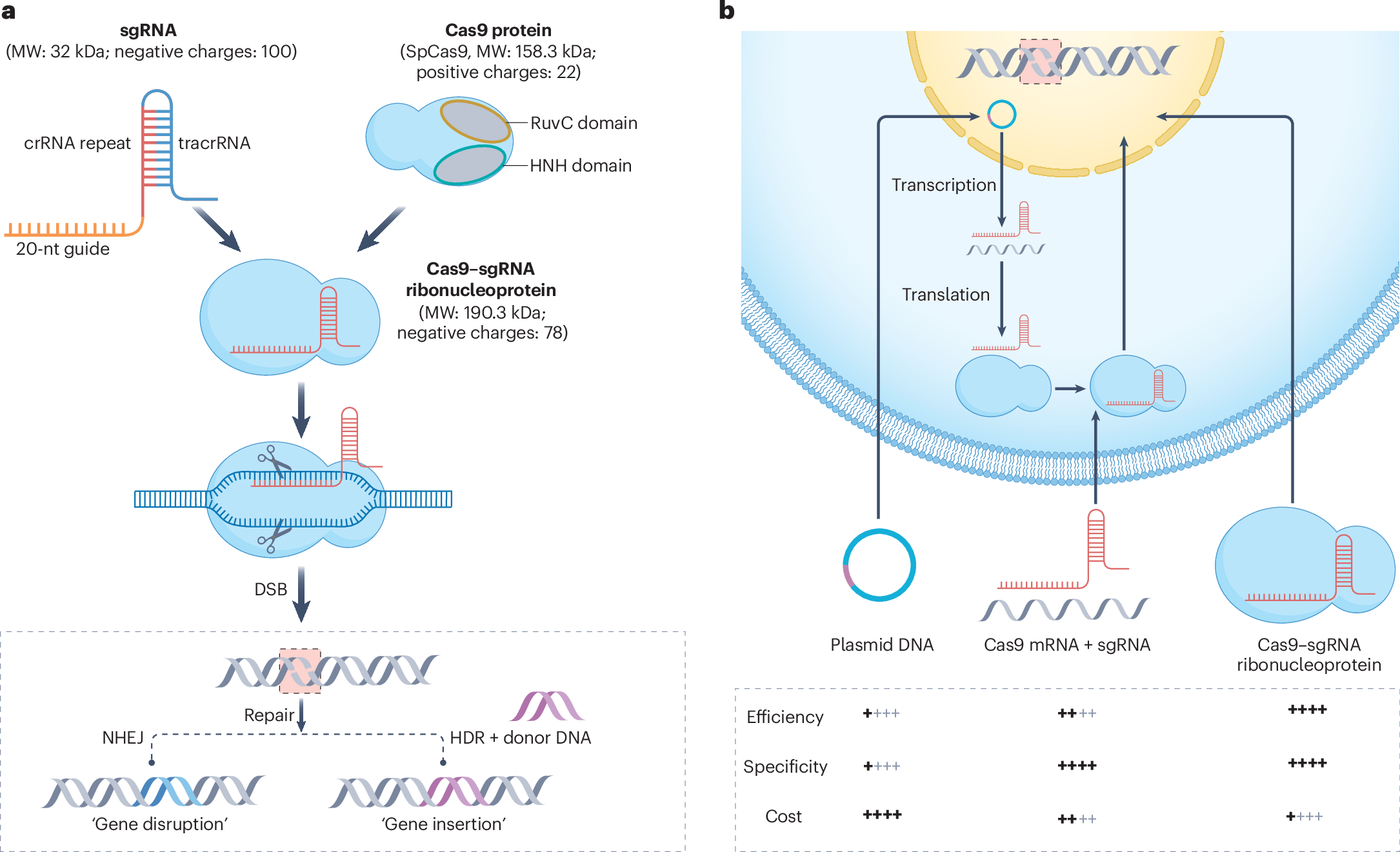
CRISPR-Cas9 can be understood as a programmable molecular targeting system. The guide RNA contains a sequence designed to recognize a complementary region of DNA. Cas9 is the associated enzyme that performs the DNA-cutting step in the standard CRISPR-Cas9 approach.
Step 1: Select a genetic target
Researchers first identify the genomic region relevant to their scientific question. Target selection involves sequence analysis, consideration of nearby DNA features and evaluation of potential unintended matching sites elsewhere in the genome.
Step 2: Design the guide RNA
A guide RNA is selected or designed to recognize the intended DNA sequence. Target specificity depends on sequence matching, the surrounding DNA context and the properties of the chosen CRISPR system. Guide design is therefore an important part of experimental planning, not a guarantee of perfect specificity.
Step 3: Deliver the CRISPR components
The editing components must reach the cells being studied. Depending on the experiment, researchers may use a ribonucleoprotein complex, RNA, DNA-based expression systems or suitable delivery vehicles. Different approaches have different advantages, limitations and implications for how long the editing machinery remains active.
Step 4: Target recognition and DNA cutting
The guide RNA helps the Cas9 system recognize the intended genomic region. Cas9 then cuts the DNA when the necessary sequence and molecular requirements are met. Other CRISPR-associated proteins and engineered variants can work differently.
Step 5: Cellular DNA repair
The cell repairs the resulting DNA break. Repair can introduce insertions or deletions that disrupt a gene. In suitable experimental settings, a designed DNA template can support a more specific sequence change through a template-directed repair pathway.
Step 6: Validate the edit
Researchers use methods such as DNA sequencing, targeted genotyping, protein analysis and functional assays to determine whether the intended change occurred. They also evaluate unintended edits, variation between cells and possible effects on the biological system being studied.
CRISPR is a tool, not an automatic solution
Successful genome editing depends on target selection, delivery, cellular repair and rigorous validation. The presence of a CRISPR component in a cell does not prove that the intended DNA change occurred or that the resulting cell will behave as expected.
3. The CRISPR Gene Editing Workflow in Research
Genome editing experiments generally combine molecular design, cell biology, genetic analysis and functional testing. The workflow differs between organisms and research objectives, but the following stages illustrate the main scientific decisions.
Define the question
Establish which gene, regulatory region or biological process needs to be investigated and what evidence would answer the research question.
Plan the edit
Select an appropriate editing approach and assess the target sequence, controls and potential unintended changes.
Deliver the system
Introduce the required editing components into the experimental cells or organism using an appropriate research method.
Characterize edited cells
Use molecular analysis to determine which cells contain the intended edit and whether different edit outcomes are present.
Measure function
Assess gene expression, protein abundance, cellular behavior or another outcome relevant to the original hypothesis.
Reproduce the findings
Compare appropriate controls, repeat experiments and report limitations so other researchers can evaluate the results.
This workflow connects CRISPR genome editing with broader research technologies such as PCR, next-generation sequencing, transcriptomics, proteomics, microscopy and bioinformatics. These complementary methods are essential for interpreting what an edit actually changes.
4. Major Applications of CRISPR Genetic Engineering
CRISPR is used in many areas of modern biotechnology. Its applications range from basic investigations of gene function to the development of engineered cells and organisms. The maturity of each application varies: some are routine laboratory methods, while others remain experimental or subject to extensive regulatory requirements.
Functional genomics and gene function analysis
One of the most widespread uses of CRISPR is to investigate what genes do. Researchers can disrupt selected genes and observe changes in cellular behavior, molecular pathways or organismal characteristics. CRISPR screening approaches can examine many genetic targets in parallel, helping researchers prioritize genes for further study.
Cell engineering and stem cell research
CRISPR can be used to modify cultured cells and stem cell models. Researchers may create isogenic cell lines that differ at a selected genetic location, allowing comparisons under controlled conditions. Genome editing is also used to investigate differentiation, cellular identity, gene regulation and the molecular basis of tissue development.
Organoids and three-dimensional cell models
Organoids are three-dimensional cell cultures that reproduce selected features of tissues. Combining organoid research with genome editing enables scientists to investigate how specific genes influence cell organization, differentiation and molecular function. These models remain simplified representations of biological systems.
Microbiology and synthetic biology
CRISPR can help researchers study microbial genes and engineer microorganisms for experimental purposes. In synthetic biology, genome editing may support the development of biological systems with selected characteristics, including changes to metabolic pathways and the production of useful biological molecules.
Plant genetics and crop research
Plant researchers use genome editing to investigate traits related to plant growth, development, crop quality and environmental adaptation. The potential outcomes depend on the crop, target gene, editing method and field conditions. Regulatory frameworks for genome-edited plants also vary by jurisdiction.
Animal models and comparative biology
In animal research, targeted gene modifications can help investigate how specific genetic changes influence development, physiology and behavior. Appropriate ethical review, welfare protections and scientific justification remain necessary when using animals.
Genome-wide CRISPR screening
CRISPR screening uses collections of guide RNAs to perturb many genes across a cell population. By measuring which perturbations affect a selected outcome, researchers can identify genes and pathways associated with the process under investigation. Sequencing and statistical analysis are important for interpreting screening results.
5. Human Genome Editing: From Laboratory Research to Clinical Applications
Human genome editing is one of the most closely examined areas of CRISPR research. Somatic genome editing targets cells in an individual and is not intended to pass genetic changes to future generations. Germline editing, by contrast, involves reproductive cells or embryos in ways that may make changes heritable.
Most genome editing research continues to focus on laboratory models, preclinical investigation and carefully regulated clinical studies. Translating a promising laboratory result into a reliable intervention requires evidence about delivery, editing accuracy, biological effects, durability and long-term safety.
An established milestone: CRISPR-based cell engineering
In December 2023, the United States Food and Drug Administration approved Casgevy, the first FDA-approved therapy using CRISPR/Cas9 genome editing, for eligible patients with sickle cell disease. The FDA subsequently approved it for transfusion-dependent beta-thalassemia in January 2024. The product uses a patient's own blood-forming stem cells, which are edited outside the body and then returned as part of a specialized medical process.
This milestone demonstrates that genome editing can move beyond laboratory research into regulated clinical use. It does not mean that every genetic condition can be addressed by CRISPR or that editing can be performed safely in every tissue. Each application requires its own evidence and regulatory assessment.
6. CRISPR in Agriculture, Food Science and Environmental Research

Genetic engineering is not limited to human cells. CRISPR can also support plant and agricultural research by allowing scientists to investigate selected genes involved in plant growth, fruit development, stress responses and crop characteristics.
Crop trait research
Scientists can investigate how selected genes influence traits such as plant architecture, ripening, composition and resistance to particular environmental challenges. Whether an edit produces a useful trait depends on the complexity of the underlying genetics and the conditions in which the plant grows.
Microbial engineering and food biotechnology
CRISPR tools may help researchers examine microbial metabolism and modify microorganisms used in biotechnology and food-related research. The suitability of any engineered organism depends on its intended application, validation, containment and relevant regulations.
Environmental research
Genome editing can contribute to studies of organismal traits and ecological processes. Proposed environmental applications, including genetic approaches involving wild populations, require particular caution because ecological effects can extend beyond the original experimental setting.
In all these fields, technical feasibility is only one consideration. Researchers must also evaluate unintended effects, ecological consequences, public engagement and the regulatory framework applicable to the organism and its intended use.
7. Beyond CRISPR-Cas9: Base Editing and Prime Editing
Standard CRISPR-Cas9 often creates a double-strand break in DNA. Researchers have developed newer genome engineering approaches that can achieve certain types of genetic changes without relying on the same cutting-and-repair process. These technologies broaden the possibilities for precision genetic research.
| Technology | General mechanism | Research opportunity | Key consideration |
|---|---|---|---|
| CRISPR-Cas9 | Uses guide RNA and a Cas9 nuclease to cut a target DNA sequence. | Gene disruption and selected DNA insertions or replacements. | Repair outcomes can vary; unintended edits must be assessed. |
| Base editing | Uses an engineered CRISPR-associated system and a base-modifying enzyme to change particular DNA letters. | Investigating selected single-nucleotide changes without a conventional double-strand break. | Compatible substitutions and editing windows are limited by the editor. |
| Prime editing | Uses a modified Cas protein and a prime-editing guide RNA to direct selected sequence changes. | Research into targeted substitutions and certain small insertions or deletions. | Efficiency and outcomes depend on the target, cell type and design. |
| CRISPRi / CRISPRa | Uses modified CRISPR systems to reduce or increase gene activity without necessarily cutting DNA. | Studying gene regulation and gene function. | Changes in gene activity depend on regulatory context and system design. |
Base editing: changing selected DNA letters
Base editors combine a CRISPR-derived targeting component with an enzyme that chemically modifies a DNA base. Certain base editors can convert one DNA letter into another within a compatible editing window. This can be useful for studying the consequences of particular nucleotide substitutions.
Prime editing: expanding the range of possible edits
Prime editing uses a modified Cas9 protein linked to a reverse transcriptase and a specially designed guide RNA. Depending on the system and target, it can support selected substitutions, insertions and deletions. It does not make every possible genetic change equally easy or efficient, and careful validation remains necessary.
CRISPR interference and activation
CRISPR interference, often called CRISPRi, can reduce gene expression, while CRISPR activation, or CRISPRa, can increase gene expression. These methods generally use modified CRISPR proteins that target DNA without cutting it. They allow researchers to investigate gene regulation and cellular responses without necessarily changing the underlying DNA sequence.
8. Why Has CRISPR Changed Genetic Engineering?
Earlier genome editing approaches, including zinc-finger nucleases and TALENs, can also create targeted DNA changes. CRISPR became especially influential because many versions can be redirected to new DNA targets by changing a guide RNA rather than redesigning an entirely new DNA-binding protein for every target.
| Feature | CRISPR systems | Earlier engineered nucleases |
|---|---|---|
| Target recognition | Often guided by a programmable RNA sequence. | Typically depends on engineered DNA-binding protein domains. |
| Target redesign | Often requires designing a new guide RNA and validating it. | Usually requires redesigning the relevant protein-binding domains. |
| Multiplex research | Multiple targets can sometimes be investigated in one experiment. | Possible, but design and implementation may be more complex. |
| Precision | Depends on the target, guide, editor, delivery and biological context. | Also depends on the design and experimental context. |
| Validation | Required to confirm intended and unintended outcomes. | Required to confirm intended and unintended outcomes. |
CRISPR is not automatically superior for every genome engineering task. The most appropriate method depends on the desired genetic change, the cell type, available delivery systems, technical requirements and the evidence needed to demonstrate a successful result.
9. Limitations, Accuracy and Safety in Genome Editing
The phrase “precision gene editing” can create the impression that CRISPR always changes only the intended DNA sequence. In practice, researchers must account for several sources of uncertainty.
Off-target editing
An editing system may alter DNA at unintended locations that resemble the target sequence. The likelihood and consequences depend on the guide, the editor, the genome and the experimental conditions. Appropriate computational analysis and experimental testing are used to evaluate potential off-target changes.
Unintended changes at the target site
Even when the intended region is targeted, DNA repair can produce unexpected outcomes. These may include larger deletions, rearrangements or different edit patterns among cells. Sequencing methods and other complementary assays help characterize the resulting edits.
Delivery challenges
Editing components must reach the intended cells in a suitable form and at an appropriate level. Some cell types are difficult to access or modify. Delivery systems may also affect efficiency, duration of activity and the overall experimental outcome.
Cell-to-cell variation
An edited cell population may contain cells with different genetic outcomes, including unedited cells and cells carrying different edits. Researchers must determine whether the population is suitable for the question being studied and whether additional isolation or characterization is required.
Biological complexity
Genes rarely operate in isolation. A change to one gene can affect multiple pathways, and the same edit may have different consequences across cell types or environmental conditions. Understanding a genetic change therefore requires functional experiments in addition to DNA sequence analysis.
10. Ethics, Regulation and the Future of Genetic Engineering
CRISPR has expanded scientific capabilities, but its use raises questions that go beyond technical performance. Ethical and regulatory considerations differ depending on whether research involves cultured cells, animals, plants, human somatic cells or human reproductive cells and embryos.
Somatic versus heritable genome editing
Somatic editing affects targeted cells in an individual and is not intended to be inherited by future generations. Heritable genome editing could transmit genetic changes to descendants. The latter raises additional questions about long-term consequences, consent from future generations, social inequality and governance.
Access and fairness
Advanced genome editing can require specialized facilities, trained teams, complex manufacturing and substantial resources. Ensuring responsible access and avoiding a future in which benefits are available only to a limited group are important policy considerations.
Environmental responsibility
Applications involving genetically modified organisms in open environments require careful assessment of ecological consequences. Potential changes to wild populations may be difficult to reverse, so governance and risk assessment are central to responsible research.
What could come next?
Future developments may improve editing accuracy, broaden the range of DNA changes that can be introduced, refine delivery methods and make functional genome analysis more informative. Integration with single-cell sequencing, artificial intelligence, computational biology and high-throughput screening may also help researchers interpret the effects of genetic modifications.
These advances are likely to make CRISPR and related tools increasingly useful across research fields. Their long-term impact will depend not only on molecular engineering, but also on rigorous validation, transparent reporting, ethical oversight and appropriate regulation.
11. Frequently Asked Questions About CRISPR Genetic Engineering
What is CRISPR genetic engineering?
CRISPR genetic engineering uses programmable CRISPR-associated systems to target genetic sequences. Depending on the system, researchers can modify DNA, alter gene activity or investigate the function of particular genes.
What does CRISPR stand for?
CRISPR stands for clustered regularly interspaced short palindromic repeats, a term describing repeated DNA sequences originally identified in microbial genomes.
How does CRISPR-Cas9 edit DNA?
A guide RNA directs the Cas9 enzyme toward a compatible target sequence. Cas9 cuts the DNA, and cellular repair processes determine the resulting genetic change.
Why is CRISPR important in biotechnology research?
It enables researchers to investigate gene function, create experimental cell models, perform genetic screens and engineer selected biological systems. It is adaptable to many different research questions.
What is the difference between CRISPR-Cas9 and base editing?
Standard CRISPR-Cas9 typically cuts both DNA strands. Base editing uses an engineered system to chemically modify selected DNA letters in compatible sequence contexts without a conventional double-strand break.
What is prime editing?
Prime editing is a genome engineering approach that uses a modified Cas9 protein, reverse transcriptase and a prime-editing guide RNA to introduce selected sequence changes. Its performance varies with the target and experimental system.
Can CRISPR be used in plants and microorganisms?
Yes. Researchers use CRISPR systems in plant, microbial, animal and cultured-cell research. The appropriate method and regulatory requirements depend on the organism and intended application.
Is CRISPR completely accurate?
No. Unintended edits, variable DNA repair and delivery limitations remain important considerations. Researchers must validate the intended genetic outcome and evaluate potential unintended changes.
Has CRISPR been used in an approved human application?
Yes. The US FDA approved Casgevy in December 2023, a product that uses CRISPR/Cas9-edited blood-forming stem cells for eligible patients with sickle cell disease. Additional approvals and indications depend on the jurisdiction and current regulatory status.
Can CRISPR edit the human genome in a way that is inherited?
Editing reproductive cells or embryos can potentially produce heritable changes. This is distinct from somatic genome editing and raises significant safety, ethical and regulatory concerns.
Will CRISPR change the future of genetic engineering?
CRISPR has already changed molecular research by making targeted genome modification more programmable. Future effects will depend on continued improvements in precision, delivery, validation, responsible use and scientific understanding.
Scientific References and Further Reading
Explore these authoritative resources for further information about CRISPR technology, genome editing applications and its limitations.
- National Human Genome Research Institute — How Does Genome Editing Work?
- National Human Genome Research Institute — What Is Genome Editing?
- National Institute of General Medical Sciences — What Is CRISPR?
- Nature Biotechnology — Genome editing with CRISPR–Cas nucleases, base editors, transposases and prime editors
- US Food and Drug Administration — CASGEVY product information
- World Health Organization — Human Genome Editing
- EuroStemCell — Genome Editing and Stem Cells: Questions and Answers
This article is intended for scientific and educational purposes. It describes research applications and does not constitute clinical, legal or regulatory advice. The capabilities and permitted uses of genome editing vary by technology, organism and jurisdiction.